The Memo Nobody Sent You: Globalization Isn’t Dead - But It’s No Longer in Charge
Why the rules of the global economy just changed forever; and what it means for your business, your town, and your bottom line
Strat Friction
4/7/20263 min read
For decades, the global economy followed a simple rule: go where it’s cheapest to produce. Capital flowed to low-cost labour. Supply chains stretched across continents. Efficiency wasn’t just a priority, it was doctrine.
That doctrine is now breaking down.
What has replaced it isn’t a recession or a temporary trade dispute. It’s something more structural: a shift toward what can best be described as Strategic Friction - an environment where resilience, control, and national security increasingly override pure market logic.
This shift didn’t arrive with a headline. It accumulated through supply shocks, export controls, geopolitical rivalry, and growing distrust in global systems. By 2026, it has become the operating reality.
The World Is No Longer Converging
The defining feature of today’s economy is not integration but rather fragmentation.
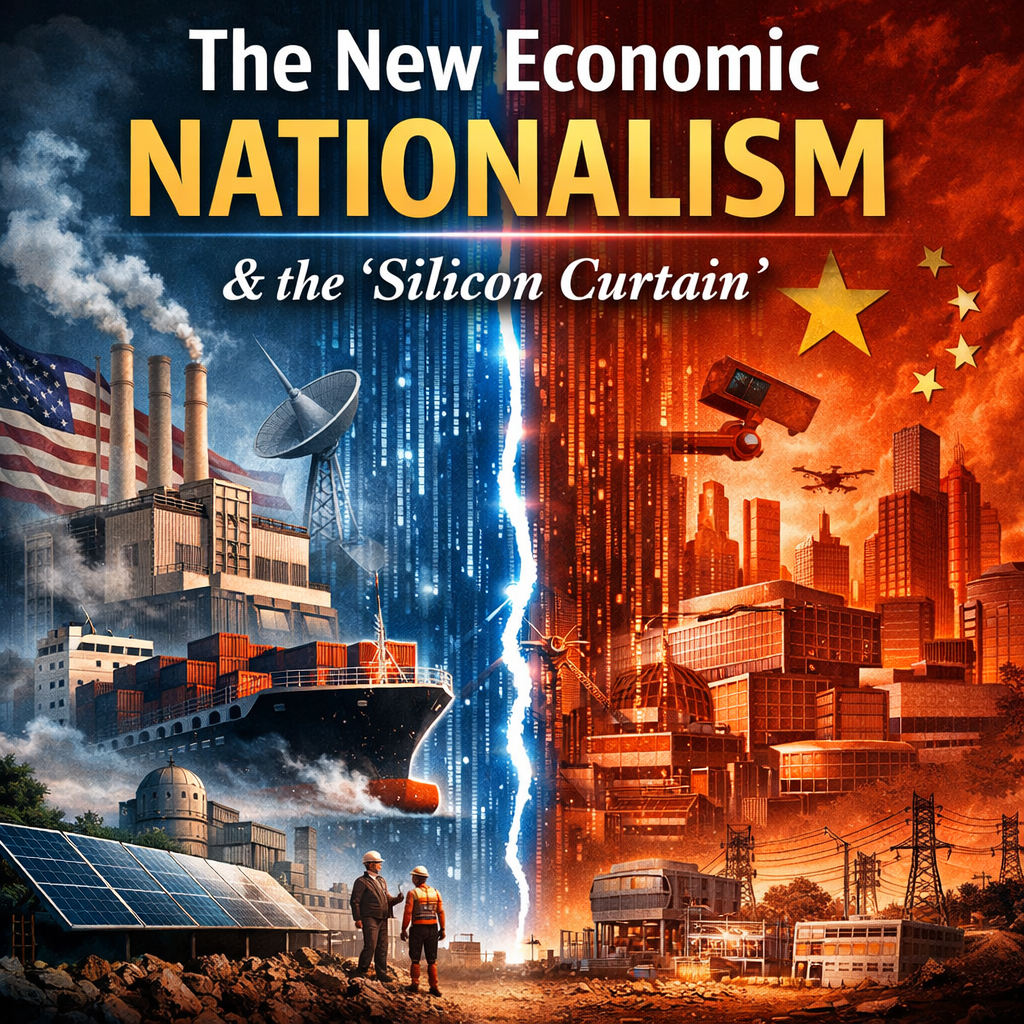
A U.S.-aligned network of partners is reorganizing supply chains around trusted jurisdictions, while China continues to develop parallel systems across technology, infrastructure, and trade. The result is not a clean split, but a growing structural divide.
In critical sectors such as semiconductors, AI and telecommunications, companies are increasingly forced to operate within one ecosystem or carefully navigate between them.
Think of it as a “Silicon Curtain”: not a fixed boundary, but a line that is becoming harder to cross without cost.
Compliance Is Now Continuous
For businesses, this shift is no longer abstract.
Export controls; particularly those administered by the Bureau of Industry and Security have expanded in both scope and enforcement. What was once a transactional process is evolving into something more persistent.
Companies are increasingly expected to understand not just where their products go, but how they are used, by whom, and under what conditions. That requires documentation, monitoring, and internal controls that extend well beyond the point of sale.
For large firms, this is manageable. For small and mid-sized enterprises, it introduces a new operational reality; one where compliance functions as a hidden cost of market access.
The Scarcity Effect Is Local Now
At the same time, global disruptions are translating more directly into local cost pressures.
Commodity markets; particularly for inputs like copper and critical minerals have become more volatile due to supply constraints, geopolitical risk, and surging demand tied to electrification and energy transition.
For businesses, this shows up not as abstract market data, but as real pricing pressure:
Contractors facing rising material costs
Energy and infrastructure startups re-calibrating financial models
Manufacturers managing thinner margins with fewer hedging options
This is Strategic Friction in its most tangible form: global instability pricing itself into local operations.
Trust Has Been Replaced by Proof
Participation in major supply chains now requires more than reliability; it requires verifiability.
Companies are increasingly expected to demonstrate that their inputs, partners, and processes are free from exposure to high-risk jurisdictions or entities. This shift toward evidence-based compliance is reshaping how firms manage vendors, track components, and document operations.
The result is a quiet but significant barrier to entry, one that disproportionately affects smaller firms without the infrastructure to support it.
The Return of Geography
There is, however, a counter-trend. As uncertainty increases, proximity is becoming valuable again.
Near-shoring, particularly into Mexico; has gained traction as firms prioritize shorter, more predictable supply chains. In many cases, companies are accepting higher input costs in exchange for reduced delivery times and greater operational visibility.
Across North America, regions with stable infrastructure, accessible labour, and regulatory clarity are attracting renewed investment. The logic is straightforward: in a less predictable world, reliability carries a premium.
Growth - With Constraints
But this shift comes with trade-offs. Large-scale industrial projects, whether manufacturing plants, battery facilities, or data centers; place significant demands on local infrastructure. Power grids, water systems, and transportation networks are becoming contested resources.
What looks like economic development at the national level can create pressure at the local level, particularly when demand begins to outpace capacity.
What Comes Next
If this phase of Strategic Friction is defined by the fragmentation of systems and the tightening of compliance, the next phase will be defined by something more physical: competition for resources.
When globally significant industries move into local jurisdictions, they don’t just bring investment; they bring scale. And that scale has consequences.
In Part II, we examine how national priorities are reshaping local infrastructure, and what happens when businesses and communities find themselves competing not with each other, but with strategic necessity.
How is this shift showing up in your environment? Are supply chains becoming more predictable; or more constrained? Are costs stabilizing or becoming harder to forecast?