
Corporate Neutrality is Dead: Security's New Reality
As political polarization infiltrates workplaces, security teams must prioritize narrative monitoring alongside traditional perimeter control. In today's climate, digital outrage can escalate into physical threats within minutes, making it crucial for executives to adapt their security strategies.
Strat Friction
6/22/20263 min read
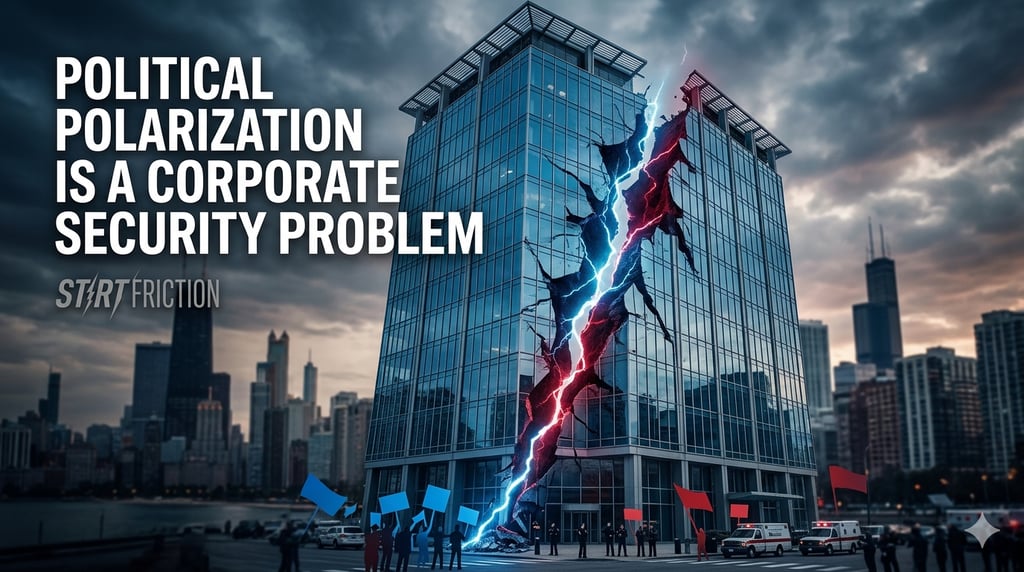
Historically, corporate boardrooms viewed political polarization through a single lens: reputational risk. It was a sensitive problem for the PR firm to tactfully respond to, a crisis to be managed with carefully worded press releases, or an issue for the Chief Communications Officer to deal with. That time has passed.
Today, ideological division isn’t just cluttering social media feeds with politically motivated campaigns and products; it is actively bleeding into the physical world; manifesting as a direct threat to corporate infrastructure, commercial real estate, front-line employees, and executive leadership.
Companies are increasingly taking positions on political, social, or cultural issues and experienced either commercial success, failure, or a bit of both.
The belief that a business can simply remain "neutral" and stay out of the cross-hairs has become a dangerous illusion. Whether by design or sheer proximity, corporations have become the new symbolic battlegrounds.
The Escalation Pipeline: From Narrative to Mobilization
When hyper-partisan narratives harden into personal identities, collective movements inevitably follow. The critical tipping point for security professionals occurs at the final stage, when words become action: mobilization.
Activated groups rarely differentiate between a government entity, a public institution, or a private corporation. If a company occupies a prominent physical space, provides a critical service, or is perceived, even falsely, to align with an opposing camp, it becomes a target.
In recent years we have seen this play out across the corporate landscape through:
Flash-protest activity and sit ins such as those used by the Occupy Movement against Class-A commercial assets and mixed-use developments.
Targeted harassment and doxxing of frontline staff and customer-facing employees as we have seen with the Palestinian protests against Jewish businesses and customers.
Vandalism and property damage disguised as political expression.
Direct, ideologically motivated threats aimed at executives and public-facing leadership.
Treating these incidents as isolated PR blunders or security failures rather than interconnected threat risk indicators is a systemic failure of assessing risk.
The Compressed Timeline: Digital Outrage to Physical Threat
The greatest challenge facing modern security teams is the absolute destruction of the reaction window.
In the past, an organization facing a controversial issue had days to gather intelligence, assess the threat, and deploy resources. Today, social media algorithms compress that timeline into minutes. A single out-of-context video, a corporate misstep, or a global geopolitical event can trigger viral outrage instantly in the span it takes to upload a video onto social media.
As a result, the emerging threat landscape now demands security professionals understand narrative environments just as well as they do physical perimeters.
Information warfare, coordinated online amplification, and digital doxxing are the modern precursors to physical breaches. While not every online firestorm results in a crowd at your front door, ignoring the digital escalation signals means you are conceding the initiative before the first protester even arrives.
Commercial Real Estate: The High-Visibility Canvas
Commercial Real Estate (CRE) assets; specifically large office towers, retail hubs, and transit-oriented developments, face a disproportionate share of this risk. They are accessible, highly visible, and symbolically potent.
To a mobilized crowd, a prominent downtown tower isn't just private property; it’s a high-visibility canvas for political messaging, a media staging location, or a convergence point to maximize disruption.
Because of this, traditional access control like turnstiles and perimeter badges, are no longer enough. Protecting an asset in a polarized environment requires an active, integrated operational posture which include:
Dynamic Protest Response: Developing scalable protocols that transition smoothly from standard operations to lock-down mode.
Cross-Functional Crisis Response: Ensuring physical security, corporate communications, and legal teams operate from a single, unified playbook.
Tenant Advisory Frameworks: Establishing rapid-fire communication channels to keep building occupants informed and secure before panic sets in.
Real-Time Intelligence Monitoring: Tracking localized, open-source intelligence to spot shifting crowd dynamics and protest planning before it reaches the property line.
The Myth of Immunity Through Neutrality
Perhaps the most pervasive flaw in current corporate strategy is the belief that maintaining strict neutrality guarantees safety. But in a hyper-polarized environment, neutrality is frequently weaponized and interpreted as complicity. Refusing to take a side is often viewed by activists as taking the wrong side.
Relying on brand equity or past goodwill to safeguard your operations is a losing strategy. Resilience isn’t built on how well you are liked; it’s built on how well you are prepared.
True operational resilience requires:
Tested Incident Management: Clear command-and-control hierarchies that don't paralyze under pressure.
Law Enforcement Integrations: Deep, pre-established relationships with local emergency services and intelligence networks.
Scenario-Based Drills: Regular, hard-nosed tabletop exercises simulating public disorder, civil unrest, and targeted corporate disruption.
The Bottom Line
Political polarization is no longer just a social or political phenomenon. It is an operational environment.
The organizations that survive this landscape intact will not be the ones trying to predict the next cultural flash-point or appease every demographic.
They will be the ones that accept the environment for what it is, actively monitor the narrative pipeline, and build the operational muscle memory to adapt the moment the tension starts to rise.
In the modern risk landscape, perception drives reality - and reality moves fast.