Part II: Resource Geopolitics - Water, Minerals, and the Local Commons
Strategic Friction
4/10/20263 min read
In Part I, we established the new paradigm of Strategic Friction: a world where the relentless pursuit of low-cost efficiency has surrendered to the demands of resilience and national security. We traced the descent of the "Silicon Curtain" and how continuous compliance and the "Scarcity Surcharge" are reshaping the operational realities of local businesses.
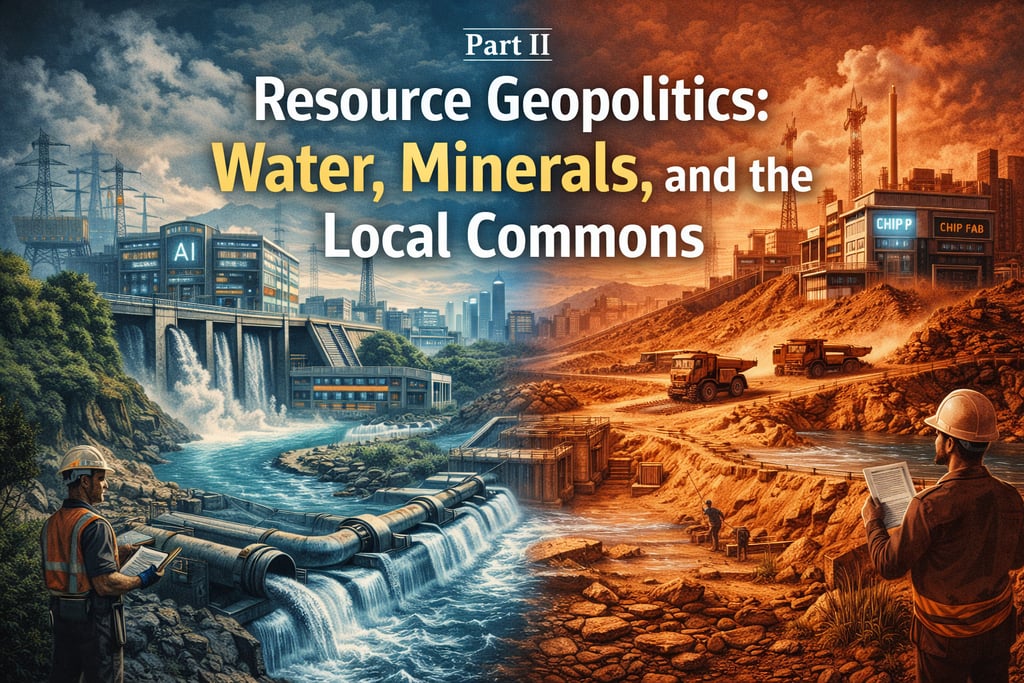
If Part I was defined by the fragmentation of systems; trade blocs and digital ecosystems - Part II addresses the fragmentation of matter. In 2026, the most visceral manifestations of geopolitical rivalry are moving downstream, landing squarely in the local common business community.
The New Geopolitics of the Neighbourhood
Geopolitics is often viewed as a high-altitude game played with carrier groups and satellite surveillance. But this view has become obsolete in the modern World of convergence and integration. Today, the front line of global competition is an electrical substation, a regional watershed, or a newly opened mine.
The 2026 battleground is tangible and local, no longer insulated from geopolitics.
As nations rush to construct the "Critical Foundations" of the next economy; artificial intelligence data centers, electric vehicle battery plants, and localized logic chip manufacturing (known as "fabs") - they are creating a massive, localized appetite for basic natural resources. The conflict is no longer just between superpowers; it is between national strategic necessity and local capacity.
When the "Nationally Strategic" Crowds Out the Local
Consider the arrival of a "nationally strategic" project in a community. A prime example is the 2025 energy crisis sparked by the collision of the AI boom and the localized grid.
The AI/Grid Conflict
When a global tech major sought to double its AI data center capacity in Northern Virginia, vital for U.S. "computational sovereignty"; it required an immediate, dedicated 500 megawatts of power. Local utilities, already facing supply volatility from a difficult energy transition, struggled. The result was not a power failure, but a prioritization shift. Grid stability was maintained by imposing higher energy "co-efficiency requirements" on existing local businesses and raising small-enterprise transmission rates to fund infrastructure upgrades. The local manufacturing base found its overhead rising not because its demand increased, but because the nation’s strategic need took precedence.
Example 2: The Water Front
A similar dynamic is playing out on the water front, the critical, invisible input for both chip fabrication and hyperscale data center cooling. A leading-edge fab (like those expanding into Arizona or Ontario) requires millions of gallons of ultra-pure water per day. In 2026, a water audit for a medical supply company now includes assessing the "draw risk" from neighbouring strategic plants, as local municipalities are forced to balance residential needs and long-standing local industries against the massive, water-intensive needs of a project backed by billions in national security grants.
How Local Leaders Must Adapt
For a community leader or business owner in 2026, navigating this environment requires a new strategic map.
Map Your "Resource Exposure": Do not rely on historical utility stability. If your operation is in the same watershed or grid sector as a Tier-1 "Friend-shoring" facility, you are now competing for that resource on a global stage.
Move from Efficiency to Resilience: If your vendor is sensitive to copper prices (which remain volatile after global supply shocks), you are exposed to a "Scarcity Surcharge." Build supplier redundancy or explore material alternatives.
Audit for Strategic Alignment: If your business—even a small-scale one—supports a strategic supply chain (e.g., medical, energy, or tech components), your operation now gains a layer of "geopolitical relevance" that may provide leverage or priority.
The Bottom Line: Geography as Strategy
The era of Strategic Friction has completed its journey from the theoretical to the physical. The global competition for resources has landed in the local utility bill and the local zoning meeting. Local geography—your proximity to stable power, clean water, and trusted allies—is no longer a logistical footnote. Geography is now your primary strategic asset.
How is this shift showing up in your environment? Are you finding your community competing for resources with new, larger-scale industrial projects? Have your costs stabilized, or are they becoming harder to forecast? Share your perspectives as we continue to track the reality of Strategic Friction.