Misalignment and Miscalculation: Why Modern Wars Expand by Default
When strategy mis-aligns and decisions accelerate, modern wars don’t just escalate: they expand, often beyond anyone’s control.
4/3/20262 min read
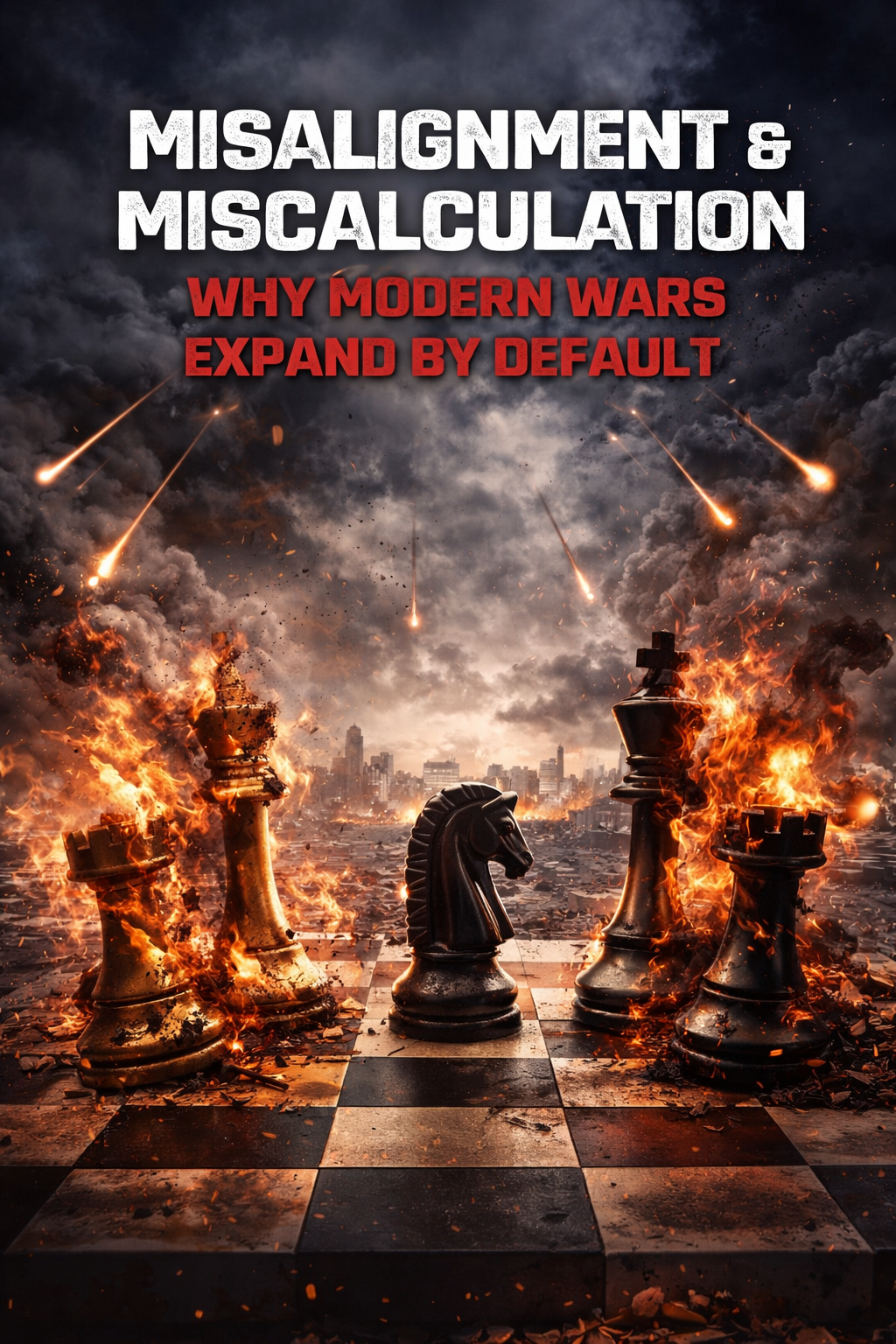
If escalation ladders are breaking, the next logical question is why conflicts are no longer stabilizing. The answer lies less in intent and more in systemic misalignment—between actors, within alliances, and across strategic objectives.
Modern wars are not expanding because leaders necessarily want them to. They are expanding because the underlying systems make contraction increasingly difficult.
Start with objective divergence. In contemporary conflicts, coalition actors rarely share identical end states. One state may seek deterrence restoration, another regime degradation, and a third simply aims to avoid regional spillover. These differences are manageable in early stages, but as operations intensify, they produce inconsistent thresholds for escalation and de-escalation.
This creates a structural problem: actions taken by one actor to achieve its objective can inadvertently trigger escalation for another. A strike deemed “proportionate” by one participant may be interpreted as existential by another. Without alignment, there is no stable ceiling—only competing interpretations of where that ceiling should be.
Layered on top of this is domestic political pressure, which is now tightly coupled with real-time information flow. Leadership is no longer operating in controlled informational environments. Public expectations, media cycles, and political opposition all compress the space for restraint. De-escalation, even when strategically rational, often appears politically untenable.
This is particularly acute in conflicts involving visible infrastructure damage or civilian impact. The demand for response becomes immediate and emotional, reducing the feasibility of measured or delayed retaliation. In effect, domestic audiences become participants in the escalation dynamic.
Another critical factor is overconfidence in deterrence signalling. States continue to believe that adversaries will interpret signals correctly—that red lines are clear, that proportionality is understood, that escalation dominance can be maintained. In reality, signalling is increasingly noisy and ambiguous.
Adversaries are operating with different risk tolerances, different intelligence pictures, and different political constraints. What one side views as a controlled demonstration of strength, the other side may interpret as preparation for regime-level confrontation. This mismatch leads to pre-emptive or disproportionate responses, further accelerating escalation.
There is also the issue of capability overhang. Many actors now possess tools—long-range precision strikes, cyber capabilities, autonomous systems—that exceed their ability to integrate them into coherent strategy. The presence of these tools creates pressure to use them, particularly under conditions of perceived vulnerability. This results in capability-driven escalation, where actions are shaped by what is available rather than what is strategically necessary.
Perhaps most importantly, there is no longer a clear mechanism for off-ramping. In previous eras, back-channel diplomacy, geographic buffers, or clear spheres of influence provided pathways to de-escalation. Today, those mechanisms are weaker or absent. Conflicts are more interconnected, more visible, and less insulated.
The consequence is a form of default expansion. Not because escalation is desired, but because every pathway out is constrained—politically, strategically, or operationally.
For practitioners and analysts, this has a direct implication: risk assessments that assume containment are increasingly unreliable. The baseline assumption should shift from “conflict will stabilize unless escalated” to “conflict will expand unless actively constrained—and even then, only temporarily.”
This is the emerging reality of modern warfare. Not a series of controlled steps, but a system of interacting pressures where misalignment, speed, and structural fragility combine to push conflicts forward.
The danger is not miscalculation in a single moment. It is the accumulation of small, rational decisions that, collectively, make escalation the only available outcome.