Insurance, Shipping, and the Collapse of “Free Trade” Assumptions
As disruption in critical chokepoints intensifies, rising insurance, rerouted shipping, and systemic uncertainty are quietly dismantling the core assumptions that global trade depends on.
Strategic Friction
3/27/20262 min read
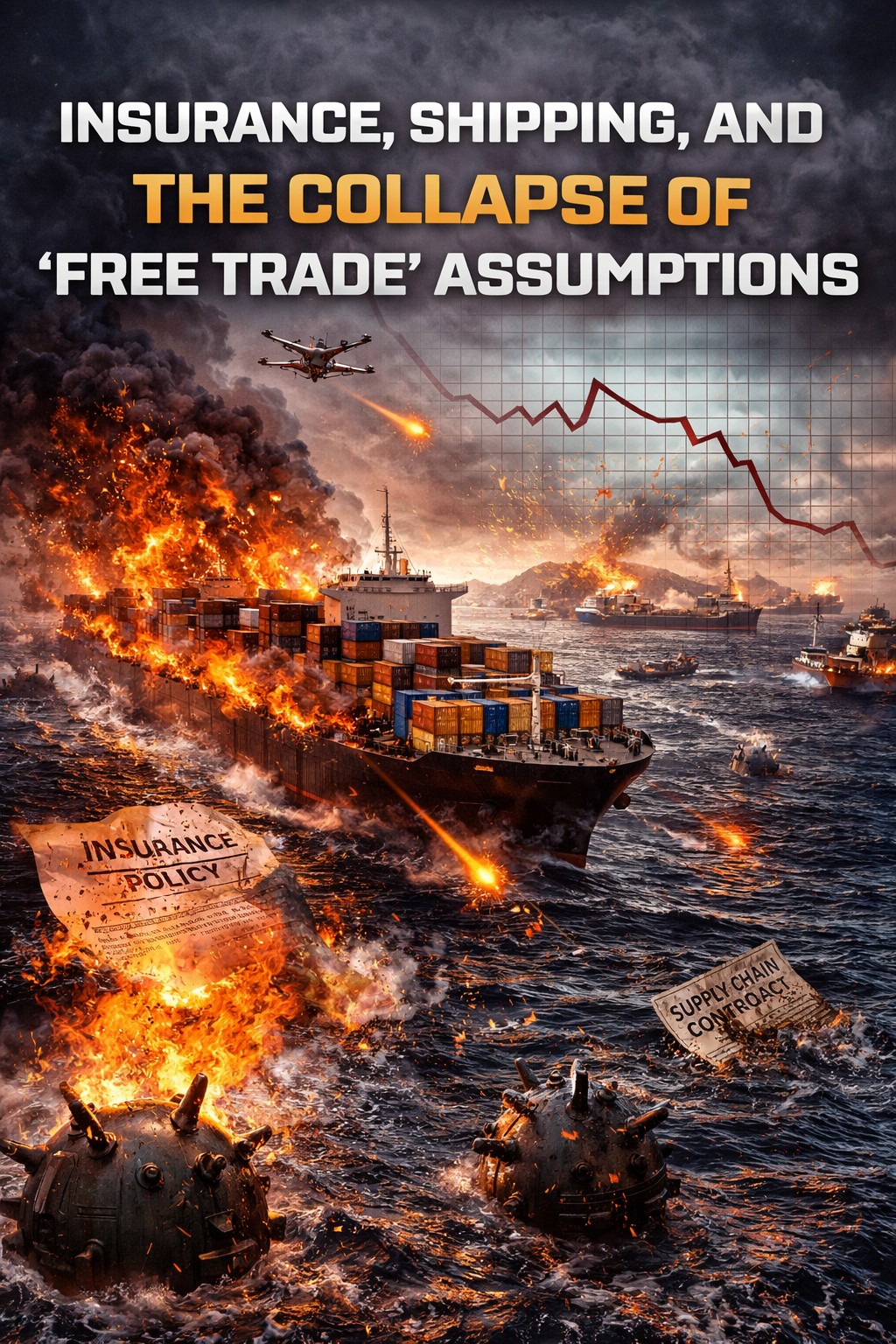
The stability of global trade has long depended on an implicit assumption: that key maritime routes would remain open, or at least reliably navigable. The situation in the Strait of Hormuz is challenging that assumption in real time.
What happens in a choke-point does not stay in a choke-point. It propagates outward through the systems that enable trade; insurance markets, shipping logistics, and financial risk models.
Start with insurance.
Maritime insurance is fundamentally about pricing risk. When the risk environment changes rapidly and unpredictably, pricing becomes more volatile. Premiums increase, coverage becomes more restrictive, and in some cases, insurers may withdraw entirely.
This has immediate operational consequences. Shipping companies must decide whether to absorb higher costs, pass them on, or avoid the route altogether. None of these options are neutral. They all introduce friction into the system.
Routing decisions are the next layer. Avoiding a high-risk choke-point often means longer journeys, increased fuel consumption, and reduced efficiency. These costs accumulate and ultimately feed into global pricing structures.
Over time, this begins to erode one of the core advantages of globalization: cost optimization through predictable, efficient logistics.
There is also a contractual dimension. Energy shipments are often governed by long-term agreements with specific delivery timelines and pricing mechanisms. Disruption introduces the risk of non-compliance, penalties, and renegotiation. This adds legal and financial complexity to an already strained system.
Financial markets respond in parallel. Increased volatility in shipping and energy flows translates into broader market uncertainty. Investment decisions are delayed, capital becomes more cautious, and risk premiums rise across sectors.
What emerges is a feedback loop. Disruption increases cost and uncertainty, which in turn reduces efficiency and investment, further weakening the system’s ability to absorb future shocks.
At a strategic level, this challenges the notion of “free trade” as a default condition.
Trade is not inherently free; it is secured, maintained, and underwritten by stable conditions. When those conditions degrade, the system does not collapse immediately, but it does become more constrained.
States and corporations begin to adapt. Supply chains are re-evaluated, alternative routes are explored, and dependencies are reassessed. This often leads to regionalization and redundancy, which enhance resilience but reduce overall efficiency.
The long-term effect is a shift in how globalization functions. Less seamless, more fragmented, and increasingly shaped by geopolitical risk rather than purely economic logic.
The key insight is that choke-points like Hormuz are not just geographic features. They are systemic stress tests. When they come under pressure, they reveal the underlying assumptions; and vulnerabilities, of the global economy.
And those assumptions are proving far less durable than previously believed.