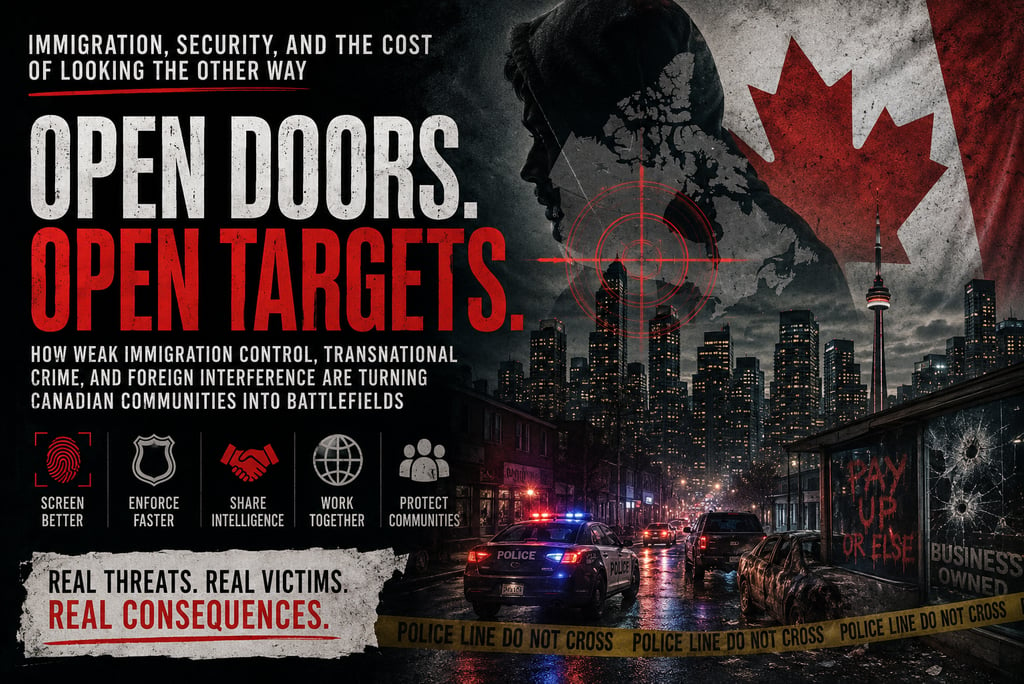
Immigration, Security, and the Cost of Looking the Other Way: A Warning Canada Can No Longer Ignore
Blog post description.
Strategic Friction
6/9/20265 min read
When gunfire erupted outside a South Asian business owner's property in Brampton after extortion demands were ignored, it was initially treated as another isolated shooting. It wasn't!
Investigators would later connect the attack to a broader extortion campaign targeting members of Canada's South Asian community. Similar incidents began appearing across the country. In Surrey, police reported dozens of extortion files linked to shootings and threats. In Calgary, businesses and residences were targeted after victims refused to pay. Peel Regional Police eventually launched a dedicated Extortion Investigation Task Force as reports climbed into the hundreds.
What appeared to be random violence was actually something far more troubling: a coordinated campaign of intimidation linked to transnational criminal networks operating across international borders.
Immigration is one of the most powerful tools a nation has.
Done well, it brings skilled workers, entrepreneurs, and families who strengthen communities, fill labour shortages, and grow economies.
Done poorly—or managed without sufficient oversight—it creates opportunities for exploitation, organized crime, and violence that governments inevitably end up trying to contain after the damage has already been done.
Canada is learning that lesson in real time.
What's Happening on Our Streets
Across Brampton, Surrey, Calgary, Edmonton, and other communities with large South Asian populations, police have been confronting an alarming surge in extortion, intimidation, shootings, and arson linked to transnational organized crime networks.
At the center of many investigations is the Lawrence Bishnoi network, an India-based criminal organization that Canadian authorities allege has established operational links within Canada.
The pattern has become disturbingly familiar.
Victims receive anonymous calls, social media messages, or encrypted communications demanding large sums of money—sometimes hundreds of thousands of dollars. Refuse to pay, and the threats often escalate. Homes are shot at. Businesses are targeted. Vehicles are torched. Families are terrorized.
As a Calgary Police Service spokesperson stated in April 2026: "Bullets are flying in the streets and we have to prevent that violence."
The numbers illustrate the scale of the problem. According to Peel Regional Police, investigators have received approximately 500 extortion-related complaints annually since 2023, the majority affecting members of the South Asian business community.
In Calgary, police reported investigating 44 extortion-related incidents over a twelve-month period, including 19 shootings directed at homes, businesses, and vehicles.
In Surrey, British Columbia, police reported 101 extortion-related investigations, 44 associated shootings, and 74 identified victims during 2025 alone.
These are not isolated incidents. They are indicators of a coordinated criminal ecosystem operating across multiple jurisdictions.
The seriousness of the threat was recognized in September 2025 when the Government of Canada formally listed the Bishnoi Gang as a terrorist entity under the Criminal Code. Public Safety Canada cited the organization's involvement in murder, extortion, intimidation, firearms offences, and organized violence.
This is not traditional street crime. It is a transnational criminal enterprise capable of projecting violence across borders and into Canadian communities.
How Did We Get Here?
The answer is not as simple as "immigration caused crime." Anyone making that argument is either oversimplifying the problem or pursuing a political agenda. The reality is more complicated.
The current crisis sits at the intersection of transnational organized crime, foreign interference, intelligence-sharing gaps, immigration fraud, border management challenges, and enforcement capacity.
Immigration itself is not the problem. Weaknesses within the systems that govern immigration, screening, enforcement, and intelligence-sharing are.
Throughout the early 2020s, Canada significantly increased both permanent and temporary resident admissions in response to economic and demographic pressures. At the same time, government agencies faced mounting challenges related to application volumes, fraud investigations, compliance monitoring, and enforcement.
Immigration, Refugees and Citizenship Canada reported reviewing thousands of suspected fraud cases each month during this period. Government data also showed growing concerns surrounding document fraud, misuse of temporary resident programs, and non-compliance with immigration conditions.
None of this proves that criminal organizations entered Canada because of immigration policy. What it does demonstrate is a basic reality of security management: Any system experiencing rapid growth without proportional investment in oversight becomes more vulnerable to exploitation.
The same principle applies to airports, banks, cybersecurity networks, and immigration systems. Criminal organizations understand this.
According to reporting from FINTRAC and multiple Canadian police services, extortion networks targeting South Asian communities frequently involve a combination of local facilitators and overseas criminal actors. These networks move money internationally, leverage social connections across borders, and exploit jurisdictional boundaries that make investigations more difficult.
The lesson is not that immigration creates criminality. The lesson is that criminal organizations actively seek out vulnerabilities, and governments ignore those vulnerabilities at their own peril.
The Wider Risk: When Organized Crime Meets Geopolitics
The extortion crisis should not be viewed solely as a policing issue. It is increasingly becoming a national security issue.
Canadian officials and law enforcement agencies have publicly alleged connections between individuals associated with the Bishnoi network and actors linked to the Government of India in relation to violent criminal activity in Canada. These allegations emerged during the diplomatic dispute that followed the 2023 killing of Sikh activist Hardeep Singh Nijjar and ultimately resulted in Canada expelling six Indian diplomats and consular officials.
Regardless of how individual investigations unfold, the broader concern is difficult to ignore.
When organized crime networks, diaspora tensions, and geopolitical rivalries begin overlapping, domestic public safety issues can rapidly evolve into foreign interference and national security challenges.
This is where immigration integrity intersects directly with security. A country does not need open borders to face these risks.
It only needs fragmented screening processes, inconsistent information sharing, overloaded enforcement systems, or intelligence gaps that prevent agencies from connecting warning signs before violence occurs.
The objective is not to prevent immigration. The objective is to ensure that governments retain the ability to distinguish between legitimate newcomers and individuals seeking to exploit the system.
What Needs to Happen
To its credit, the federal government has begun responding. The Strong Borders Act and the federal Border Plan introduced enhanced enforcement authorities, expanded intelligence capabilities, increased fraud detection measures, and additional resources aimed at combating transnational organized crime. The government also announced approximately $1.3 billion in border security investments.
According to federal data, nearly 19,000 foreign nationals were removed between January and October 2025 for violations of the Immigration and Refugee Protection Act, including hundreds of removals involving serious criminality, organized crime, and national security concerns. Those measures are necessary. They are also overdue.
Canada; and frankly any country watching these developments, including the United Kingdom and several European states; needs a framework built around five principles:
Rigorous screening. Admission targets should never exceed the government's ability to properly vet applicants.
Credible enforcement. Rules only matter if violations carry consequences.
Integrated intelligence. Immigration authorities, police services, intelligence agencies, and financial crime investigators must share information more effectively.
International cooperation. Transnational crime requires transnational responses. Criminal networks do not respect borders, and neither can the investigations targeting them.
Protection of vulnerable communities. The primary victims of these extortion campaigns are overwhelmingly law-abiding South Asian Canadians, many of whom immigrated to Canada precisely because they believed it offered security and stability. They deserve both.
The Broader Principle
Immigration is not inherently dangerous. The overwhelming majority of immigrants contribute positively to Canadian society, strengthen communities, build businesses, and create opportunities for future generations. But successful immigration requires public confidence.
That confidence depends on the belief that governments know who is entering the country, can identify those who pose risks, and are willing to act when those risks materialize.
When families are afraid to report extortion demands, when businesses are targeted by organized violence, and when foreign criminal networks begin operating inside Canadian communities, that confidence erodes.
Sound immigration policy is not anti-immigrant. It is one of the foundations that makes immigration sustainable.
Canada is learning that lesson the hard way. The question now is whether policymakers will apply it before today's organized crime problem evolves into tomorrow's national security crisis.
Sources and Footnotes:
Peel Regional Police extortion task force briefings and media releases (2024–2026).
Calgary Police Service organized crime and extortion updates (2025–2026).
Surrey Police Service / RCMP Joint Extortion Investigation Team reporting (2025–2026).
Public Safety Canada terrorist listing of the Bishnoi Gang (September 2025).
FINTRAC Operational Alert on transnational organized crime and extortion.
IRCC annual reports on immigration fraud investigations.
CBSA enforcement and removals statistics (2025).
Federal Border Plan and Strong Borders Act documentation.