Hormuz Under Fire: Anatomy of a Modern Maritime Denial Strategy
When the world’s most critical choke-point becomes contested battle-space, disruption; not dominance, emerges as the fastest way to reshape global trade and energy flows.
Strategic Friction
3/24/20262 min read
The Strait of Hormuz has always been a critical piece of the global shipping system. What has changed recently is how vulnerable it has become; and how central that vulnerability is to modern conflict strategy.
Roughly a fifth of the world’s oil supply transits through this narrow corridor. That alone makes it significant. But volume is only part of the equation. What matters more is the lack of viable alternatives. There are limited routes that can absorb this level of traffic if the strait is disrupted, and the alternatives that do exist come with higher costs and lower capacity.
The Straight of Hormuz in fact creates a classic choke-point dynamic; high throughput, low redundancy, and significant global dependency.
Modern maritime denial strategies are built around exploiting exactly this kind of environment. The objective is not necessarily to close the strait entirely, which would require sustained military control. But rather, to make transit through the straight unpredictable, risky, and economically unattractive.
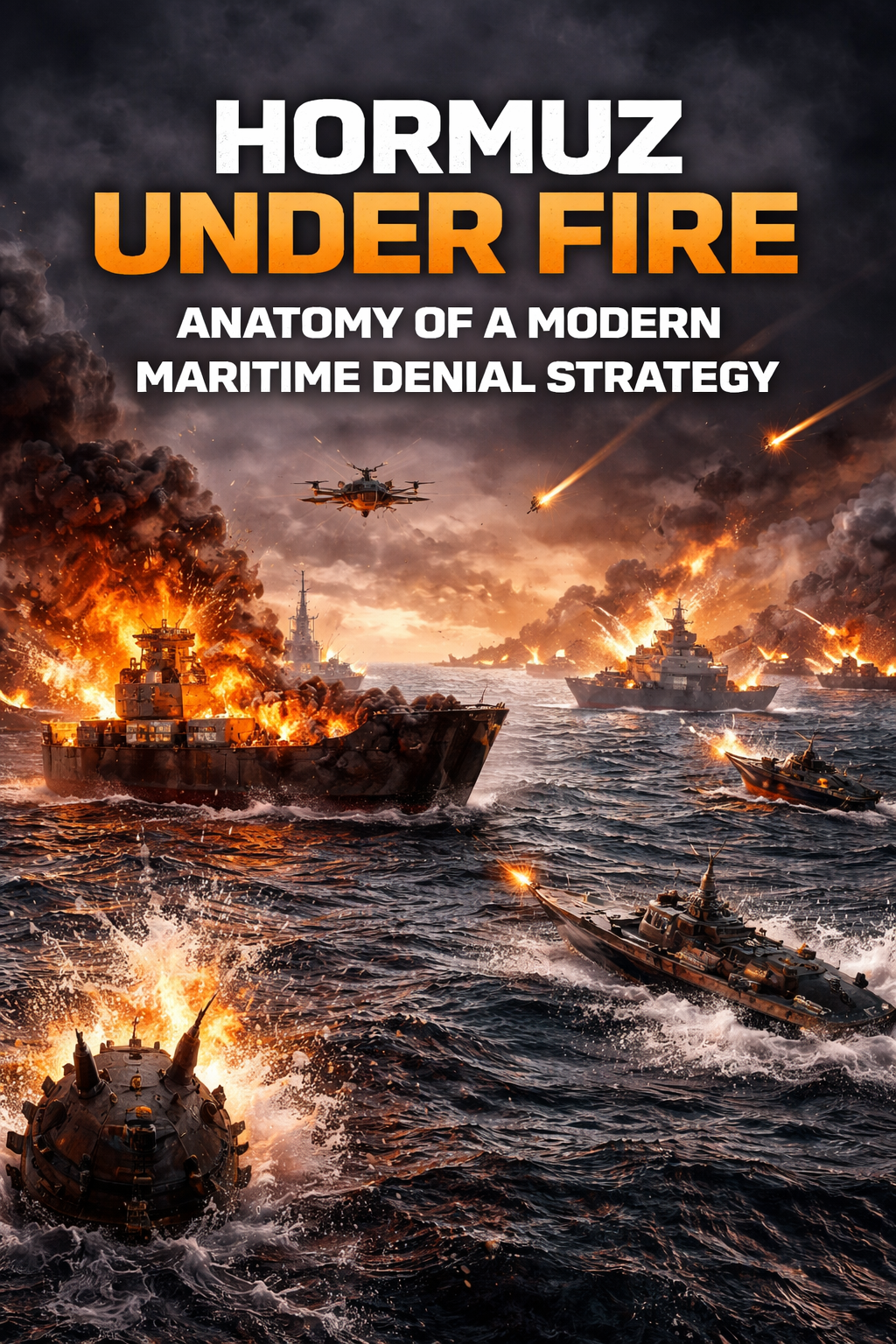
This is achieved through a combination of capabilities and tactics such as anti-ship missiles, naval mines, fast attack craft, drones, and increasingly, cyber operations targeting navigation and port systems.
None of these tools and weapons need to be deployed at scale to be effective. The goal is disruption, not domination.
Even limited incidents, like we have already seen such as attacks on individual vessels, near misses, or credible threats; can have disproportionate effects.
Shipping companies operate their business based on risk calculations. Increase the perceived risk, and their behavior has to change: routes are altered, insurance premiums go up and transit slows.
This is where maritime denial becomes a form of economic leverage. You do not need to stop the flow entirely; you only need to complicate it enough to introduce cost and uncertainty. These risks are further amplified when you are talking about massive oil tankers carrying millions of barrels of oil.
Naval power still plays a role, but it is increasingly reactive. Escort missions, surveillance, and deterrence patrols can mitigate risk, but they cannot eliminate it. The operating environment favors the actor willing to accept higher levels of ambiguity and escalation risk.
There is also a signalling component. Actions in and around the strait are rarely isolated. They are part of a broader communication strategy; demonstrating capability, testing responses, and shaping perceptions of control.
The challenge for external actors is that overreaction and under-reaction both carry risk. A strong military response may escalate the situation further, while restraint may be interpreted as weakness, inviting additional disruption.
This creates a narrow operational window where maintaining stability requires constant calibration.
The broader implication is that the Strait of Hormuz is no longer "just a transit route"; but rather it has become an active battle space, where economic and military considerations are tightly intertwined.