
Escalation Ladders Are Breaking: The Illusion of Control in Modern Conflict
We built an entire theory of war around a ladder that may never have existed. Current conflicts are proving it.
Strat Friction
3/31/20262 min read
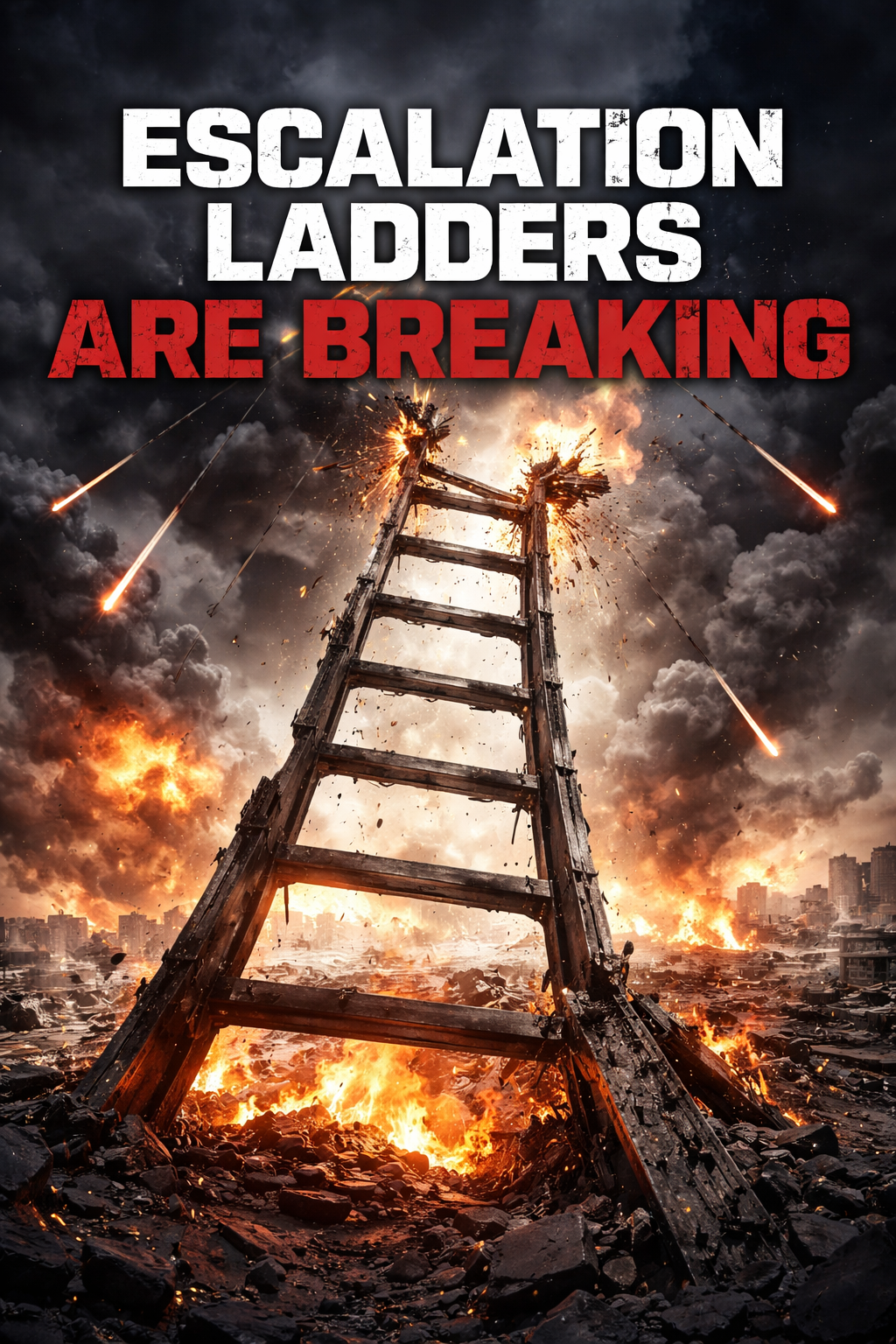
For decades, escalation theory rested on a relatively clean assumption: that states could move up and down a “ladder” of force with some degree of control. Limited strikes could signal intent without triggering full-scale war. Proxies could absorb pressure. Geography could contain violence.
What current conflicts are demonstrating; most clearly in the unfolding confrontation involving Iran and its adversaries - is that escalation is no longer linear. It is simultaneous, multi-domain, and increasingly automated in its responses.
The traditional escalation ladder has not just become unstable - it has effectively collapsed.
The Compression Problem
At the core of this breakdown is compression of decision time.
Precision strike capabilities, real-time ISR (intelligence, surveillance, reconnaissance), and networked command structures have reduced the gap between action and retaliation to near-zero. A strike on infrastructure is no longer a discrete event; it is the opening node in a chain reaction.
Political leadership is often responding not with deliberation, but under the pressure of pre-delegated military responses and public expectation cycles.
"Limited Strike" Has Lost Its Meaning
Second, the concept of “limited strike” has lost credibility. When energy infrastructure, ports, or critical logistics nodes are targeted, the downstream effects are inherently strategic. Disrupting a refinery or shipping lane does not stay local; it impacts global pricing, supply chains, and domestic stability in third-party states. In that environment, even a tactically limited action produces strategic-level consequences, forcing responses that exceed the original scope.
Proxies Have Inverted Their Function
Third, proxy warfare; once a buffer against escalation, has inverted. Instead of containing conflict, proxies now function as force multipliers within an integrated battle space. Their actions are no longer deniable in any meaningful sense. Attribution is faster, retaliation is broader, and the political tolerance for indirect engagement has narrowed. What was once a grey zone is now treated as an extension of direct conflict.
Military Speed vs. Political Control
There is also a structural misalignment between military capability and political control. Modern militaries are optimized for speed, precision, and initiative. Political systems, particularly in democracies, are slow, fragmented, and reactive. This creates a gap where military actions can outpace political intent, effectively dragging leadership up an escalation curve they did not explicitly choose.
Cross-Domain Coupling: The Multiplier No One Controls
The final and most underappreciated factor is cross-domain coupling. Escalation is no longer confined to kinetic exchanges of high tech weapons and military engagement. Cyber operations, economic retaliation, energy disruption, and information warfare are all triggered in parallel. A strike in one domain now activates responses across several others, creating a feedback loop that is difficult to dampen.
This is where the illusion of control becomes most dangerous.
Decision-makers continue to operate under legacy assumptions; that signalling can be calibrated, that retaliation can be contained, that adversaries will interpret actions within a shared framework of restraint.
They don't, they aren't and they won’t.
Instead, each action is interpreted through worst-case assumptions, amplified by speed, domestic pressure, and alliance expectations. The result is not a ladder, but a cascade; a system where escalation is less about choice and more about momentum.
The Question
The implication is straightforward: modern conflicts are no longer managed through incrementalism.
Once initiated, they tend to expand horizontally and vertically at the same time.
The real question is no longer how to climb the escalation ladder; it is whether that ladder exists at all.
An assumption that is now being tested in real time.